
 RETURN TO ALL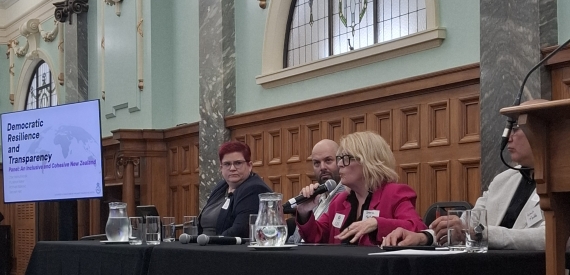
Talking in the Grand Hall of Parliament at the conference
Democratic Resilience, Transparency, and an Inclusive New Zealand
Tēnā koutou katoa,
It is a privilege to speak today on democratic resilience and transparency, and in particular, what an inclusive and cohesive New Zealand requires of us now.
I want to begin with a simple proposition:
A democracy is only as resilient as the sense of belonging felt by its most vulnerable communities.
If people feel excluded, targeted, or unsafe, then democratic participation weakens. Trust erodes. And the system itself becomes more fragile.
Over the past few years, we have seen a noticeable shift in New Zealand. Since COVID, there has been a growing lack of social cohesion. Public discourse has become sharper, more polarised, and at times more hostile.
Institutions, like the media, once trusted sources, are no more trusted as evidenced by the Edelman Trust barometer. The Barometer in 2025 showed:
Government: ~45% (falling)
Media: ~35%
Three important observations:
· Government is now one of the least trusted institutions
· Trust has collapsed most dramatically in the Media, which is needed for a functioning democracy.
· Trust is not evenly distributed. It is lower among:
o younger people
o Māori
o regional communities
o lower-income groups
Distrust is not just cultural. It is also material. Where people feel economically excluded or left behind, trust declines, grievance rises, and the appeal of simple, often harmful explanations grows.
One of the clearest and most concerning phenomena we are seeing globally is the rise in antisemitism. As chair of the Holocaust Centre of New Zealand, I see this starkly in NZ.
According to Police, NZ Jews are disproportionately targeted for hate compared to other ethnic groups. Jewish NZers make up .2% of the population, yet, for example, 13% of all reported hate crimes last year were against Jews.
Jewish communities are reporting:
- Increased online abuse and harassment
- Hate-mail
- Physical threats, including assaults, directed at individuals, synagogues and other Jewish institutions
- A normalisation of hateful language
- Jewish children being made unsafe in schools – many have had to move schools and hide their identity.
- Denial of Jewish identity and voices
These are not abstract concerns. They are real, lived experiences. They are occurring in a country that prides itself on tolerance, fairness, and inclusion.
Antisemitism is of course not the only hatred we see in New Zealand, but it is often described as a “canary in the coal mine” – a precursor for what is to come and an indication of what is. When it rises, it is rarely an isolated phenomenon. Whilst every Jew was a victim of the Holocaust, not all victims were Jewish.
It is usually a signal of wider social fracture, of conspiracy thinking, of distrust in institutions, and of a willingness to dehumanise others.
We have seen already the effect of hate on the Muslim community with the murder of 51 people in the ChCh mosques.
We, of all people, should take seriously the recent warning from the Director-General of the New Zealand Security Intelligence Service. He has said that terrorism remains a realistic possibility in New Zealand, and that a lone-actor attack — similar to the Bondi incident in Australia — could occur here.
That is a sobering assessment.
The same ecosystem that fosters antisemitism — conspiracy theories, online radicalisation, distrust of institutions — is also the ecosystem in which lone actors emerge.
So what does this have to do with a cohesive and inclusive NZ that supports democratic resilience and transparency?
Everything.
Because democratic resilience is not just about institutions, it is about people.
It is about whether people feel:
- safe;
- represented;
- heard; and
- connected to one another
When communities feel targeted or excluded, they withdraw. And when they withdraw, democracy loses voices, perspectives, and legitimacy.
This brings me to the question of inclusivity — and the role of our electoral system.
I had the privilege of chairing the Independent Review of Aotearoa New Zealand’s electoral laws. It was a once in a generation opportunity to review our electoral laws.
It posed the question of how we make our electoral system clearer, fairer, and more accessible so as many people as possible can take part in it.
We looked at many things including:
- Removing unnecessary barriers to enrolment and voting
- Improving access for people with disabilities
- Ensuring young people can engage earlier
- Making processes simpler and more transparent
But accessibility is not just about mechanics. It is also about whether people feel that the system belongs to them. And here is where I think the connection lies.
If antisemitism, or any form of hate, creates an environment where a community feels unsafe or unwelcome, then no amount of technical accessibility will be sufficient.
You can make voting easier and systems more equitable, but if people feel marginalised, they are less likely to engage.
So inclusivity must operate on two levels:
- Structural inclusion — the design of our democratic systems
- Social inclusion — the culture that surrounds those systems
Both are essential. And both reinforce each other.
At its core, democracy is a way of managing difference. In a healthy democracy, people hold different identities, beliefs, histories, and political views and the system allows those differences to coexist without tipping into conflict.
Democracy provides us with the ability to live with disagreement, constructively.
Antisemitism cuts directly across that.
Because it does not simply express disagreement with a group. It reframes that group as fundamentally suspect, powerful, or dangerous.
Historically and today, antisemitism operates through narratives that:
- reduce complexity into simple binaries: “us versus them”
- attribute hidden power or control to Jewish people or institutions
- portray Jews as outsiders
It turns diversity into division.
It also has a second, deeper effect.
Antisemitism is often tied to conspiracy thinking. Ideas about hidden influence, manipulated systems, or “elites pulling the strings” are recurring features. Those ideas don’t stay contained. They spill over into how people view democratic institutions:
- elections are seen as rigged
- media as controlled
- government as illegitimate
- expertise as untrustworthy
So the same thinking that fuels antisemitism also corrodes trust in democracy.
There is also a pattern we see repeatedly.
When societies become more polarised and less trusting, minority groups are often used as explanations for wider anxiety. They become scapegoats for complex problems.
That is why antisemitism tends to rise at moments of social strain. Not because it is new, but because it is a ready-made narrative that simplifies uncertainty.
So when we respond to antisemitism, we are doing more than addressing harm to one community.
We are pushing back against:
- binary thinking instead of nuance
- conspiracy instead of evidence
- exclusion instead of belonging
In other words, we are reinforcing the settings that democracy depends on.
So what do we do?
I would suggest three areas of focus.
First, we must name the problem clearly.
Antisemitism is not just another form of prejudice. It has unique characteristics, long historical roots, and modern manifestations that are evolving rapidly, particularly online.
We need better data, better understanding, and a willingness to confront it directly.
Second, we must invest in education and social cohesion.
This includes:
- Equipping young people to recognise misinformation and hate and be critical thinkers
- Creating spaces for dialogue across communities. That’s why the Harmony Accord between the Jewish and Muslim communities is so important.
- Teaching the history of the Holocaust and its contemporary relevance. This is being taken care of with the draft social sciences curriculum
Social cohesion does not happen by accident. It requires deliberate effort.
Third, we must ensure that our democratic systems actively support inclusion.
This means:
- Continuing to remove barriers to participation
- Ensuring transparency so people trust the system
- And recognising that inclusion is not just about access, but about belonging
Let me finish where I began.
A democracy is only as resilient as the sense of belonging felt by its most vulnerable communities.
If we want an inclusive and cohesive New Zealand, we must ensure that all communities, including Jewish New Zealanders, feel safe, valued, and able to participate fully in our shared civic life.
Because when they do, our democracy is stronger.
Ngā mihi nui.